Showing posts with label Direct Shipment. Show all posts

August 13, 2008

PA Direct Wine Shipping Update

Chateau Mouton Rothschild 2003

In April, I wrote an article for City Paper about the status of direct wine shipping in PA. The article discussed the two bills pending in the state legislature—a bill by Rep. Paul Costa (D. Allegheny County) that would allow only wineries to ship wine into PA, and a bill by Sen. Jim Ferlo (D. Allegheny County) that would also allow retailers to do so.

Costa said he planned to hold hearings this summer on his bill. According to a recent article in The Morning Call, the hearings have started. The legislature may not get to vote on the bill, however, before the end of session. If that happens, Costa will have to reintroduce his bill next year.

That doesn’t bother me—based on The Morning Call article, it appears the legislature needs a little more time to get all of the issues into focus.

The first hearing—which was held at a vineyard in Chester County—seems to have been spent discussing how much money leveling the playing field will cost in-state wineries, which Costa admitted to me in April was one of his main concerns. According to the article, the 18% Johnstown Flood Tax historically has not been levied on wine bought directly from in-state wineries. PA wineries are complaining that the proposed law—which would impose this tax on their wine, the same tax that’s long been imposed on all out-of-state wines—will give out-of-state wineries an advantage.

Even setting aside the logical absurdity that leveling the playing field results in an “advantage” here, cutting in-state wineries a break is precisely why PA’s prior direct shipping laws were declared unconstitutional. Debating whether the field should be leveled doesn’t advance the ball because continuing to have an uneven playing field is no longer an option. The focus now is supposed to be on finding a way for wine to be shipped into PA from out-of-state while still preserving the state’s ability to collect the 18% Johnstown Flood Tax and prevent underage drinking. It’s not clear from the article whether this was discussed at the first hearing.

In addition, it doesn’t appear from the article that there has been any discussion of allowing retailers to ship wine into PA. Consumers often times are not able to buy wine directly from the winery, especially if the wine is made outside the U.S. Failing to discuss retailers at the hearings would reflect a fundamental misunderstanding of how the wine market works. Practically, if the new law does not include retailers, it will be of little use to most of the folks who would take advantage of it.

Even though Ferlo’s bill is by far the better piece of legislation (it allows retailers to ship directly to your door, requires an adult signature for delivery, and accounts for the collection of PA taxes), Costa was the one who had the connections to get the hearings moving. Back in April, though, Costa told me he was open to solutions other than the ones proposed in his bill. We’ll have to wait until the next hearing to see if that’s true.

William Penn once wrote, “Governments, like clocks, go from the motion men give them….” Much like an old clock, legislative progress sometimes is slow. In terms of ironing out the direct wine shipping laws, the lack of speed is frustrating, but it can be tolerated. That is, of course, assuming the time they spend will lead to them getting it right.

Read More....

May 31, 2007

The Status of Direct Wine Shipping in Pennsylvania

In November 2005, the Pennsylvania law that allowed in-state wineries to ship wine to Pennsylvania residents but prohibited out-of-state wineries from doing so was declared unconstitutional. Last June, Governor Rendell proposed legislation that would allow Pennsylvania consumers to have wine shipped directly to their doors from out-of-state wineries (which I blogged about here). As part of Rendell’s proposal, the wineries would be required collect PA’s 18% Emergency Tax (a/k/a/ the “Johnstown Flood Tax”).

Ever wonder what happened to Rendell’s proposal? The PA legislature put it on the back burner. An article in today’s Pittsburgh Post-Gazette explains why:


Because the buyers of Pennsylvania wines make up such a minority of overall wine consumers, and account for such a small percentage of the state’s wine and spirits business, the issue isn't on the front burner in Harrisburg.

Instead, the respective House and Senate committees -- the Liquor Control Committee in the House, and the Law and Justice Committee in the Senate -- are dealing with beer-related issues: whether Sheetz and other convenience stores and supermarkets can sell beer to go, and whether distributors can sell 18-packs.


The PA legislature is clearly a few bottles shy of a case on the direct shipping issue. This proposed law isn’t about Pennsylvania wines or those who buy them. It’s about making sure the state can collect the 18% Johnstown Flood Tax on non-Pennsylvania wine that is purchased through the Internet and shipped into PA. What’s even more bizarre is that the legislature appears to be oblivious to the fact that these Internet wine sales are happening right now. That’s right—currently, there are Internet sites out there that will sell you wine and ship it directly to your door in PA. So, while the legislators wrestle with the heady issue of whether PA’s archaic liquor laws will allow WaWa to sell a six of Bud, the state is hemorrhaging money in lost taxes as its residents take advantage of wine deals on the Internet.

Not having to pay the Johnstown Flood Tax when they order wine over the Internet sounds like great deal for PA consumers. But if getting burned on lost revenue isn’t enough to convince the legislature to move this issue to the “front burner,” perhaps they should no longer be allowed to operate the stove.

Read More....

June 07, 2006

Rendell Uncorks PA Wine Shipping Plan

The Philadelphia Inquirer reported today that Gov. Rendell has proposed legislation that would allow Pennsylvania consumers to have wine shipped directly to their door from out-of-state wineries. As part of the proposal, the wineries must collect PA’s 18% Emergency Tax (a/k/a/ the “Johnstown Flood Tax”).

This is a good plan.

The Inquirer article, however, implies that the glass is only half full. The article appears to express disappointment with Rendell’s proposal, stating that the “rub” is that the plan includes the consumer paying the 18% Johnstown Flood Tax on direct shipments. This apparent criticism is a bit unfair.

First, the Johnstown Flood Tax had to be part of the deal. In a Feb. 20, 2006 Inquirer article, Rendell said he “would support direct shipments of wine to Pennsylvanians if it can be done with minimal loss of state revenue.” He’s talking about the Johnstown Flood Tax. The state has been feeding from that teat for over 70 years. It ain’t letting go now, if ever. Rendell admitted that the state needs that money. So there was never going to be a direct shipping law that did not include the Johnstown Flood Tax. That’s the political compromise. If people want inexpensive wine, the PLCB has plenty of offerings in their stores. The people who are going to be ordering directly from wineries aren’t going to mind paying the taxes they’ve already been conditioned to pay in exchange for the ability (finally) to choose what to drink.

Second, Rendell’s proposal could have been worse:

  • It could have banned direct shipments altogether. PA’s law was declared unconstitutional on Equal Protection grounds. Banning all direct shipments—from both in-state and out-of-state wineries—would have complied with the U.S. Supreme Court’s decision. Sadly, this is what some other states, such as Alabama, chose to do in response to the ruling. So, at least we’re not Alabama.

  • It could have had the wine being shipped directly to state stores instead of your door. Proponents of this option argued that if direct shipment is allowed at all, the shipments must go directly to the state stores because (1) that’s the only way to collect the Johnstown Flood Tax; and (2) underage kids would be ordering wine. Both of these arguments have been debunked. Taxes can be collected through a license procedure, which is part of Rendell’s plan. That’s how other states have done it, and if you couldn’t figure that one out, you probably don’t deserve to be a state legislator. Also, other states haven’t had any problems with direct shipment leading to underage drinking.

  • It could have made direct shipment even more expensive. My understanding is that if you want to order wine through the PLCB’s Special Liquor Order (“SLO”) process, they tack on a 30% mark-up in addition to the Johnstown Flood Tax. When Rendell signaled that the direct-shipping plan needed to be done “with a minimal loss of state revenue,” it was unclear how the 30% mark-up factored into the equation. If you could order directly from the winery, there would be no need to do an SLO, which would mean lost revenue for the state. While taxes can be collected from the out-of-state wineries through the permit process, the 30% mark-up may be a different story. So, my concern was that the proposal actually would include an increase to the Johnstown Flood Tax to make up for any anticipated loss in revenue from potentially not being able to collect the 30% mark-up. It didn’t. Be thankful.

But there may be a few bugs in Rendell’s proposal. It is not clear from the Inquirer article whether the proposal allows restaurants to order directly from out-of-state wineries. The article says that Pennsylvania wineries would lose their right to ship directly to restaurants. However, Kevin Joyce, the owner of the Carlton Restaurant in Pittsburgh and the president of the Pennsylvania Restaurant Association, implies that the ban extends to out-of-state wineries as well. If Joyce is correct, that could be a problem. First, it may raise further Equal Protection issues. Second, if out-of-state wineries can’t ship directly to restaurants, it could be a disincentive for out-of-state wineries to apply for direct shipping permits. And, ultimately, that could translate into consumers not having that many additional choices, which was the whole point of allowing direct shipment in the first place.

Read More....

April 11, 2006

I'm Famous!

Well, they say you always remember your first. So, my sincere thanks to Philadelphia Will Do for linking to my April 10 Wine Spectator post.

Philadelphia Will Do honed in on what I believe is the primary drawback of the PLCB’s distribution system—limitations on our choice of wine.

To be fair to the PLCB, though, in the instance of the 2002 Mark West Pinot Noir Russian River Valley, it IS possible that the PLCB did have some at one time and wines from the Russian River Valley ARE produced in limited quantities. But that only serves to illustrate the criticism that Philly Will Do and I share—the PLCB’s bulk “buying power” model often doesn’t give you the opportunity to experience some of the smaller, more popular productions, and the PLCB’s draconian limitations on direct shipment prevent you from getting them on your own.

Thanks again to Philadelphia Will Do. Also, thanks to Philly Future for listing me on their blog roll.

Read More....

April 10, 2006

Philadelphia Restaurants Featured in Wine Spectator

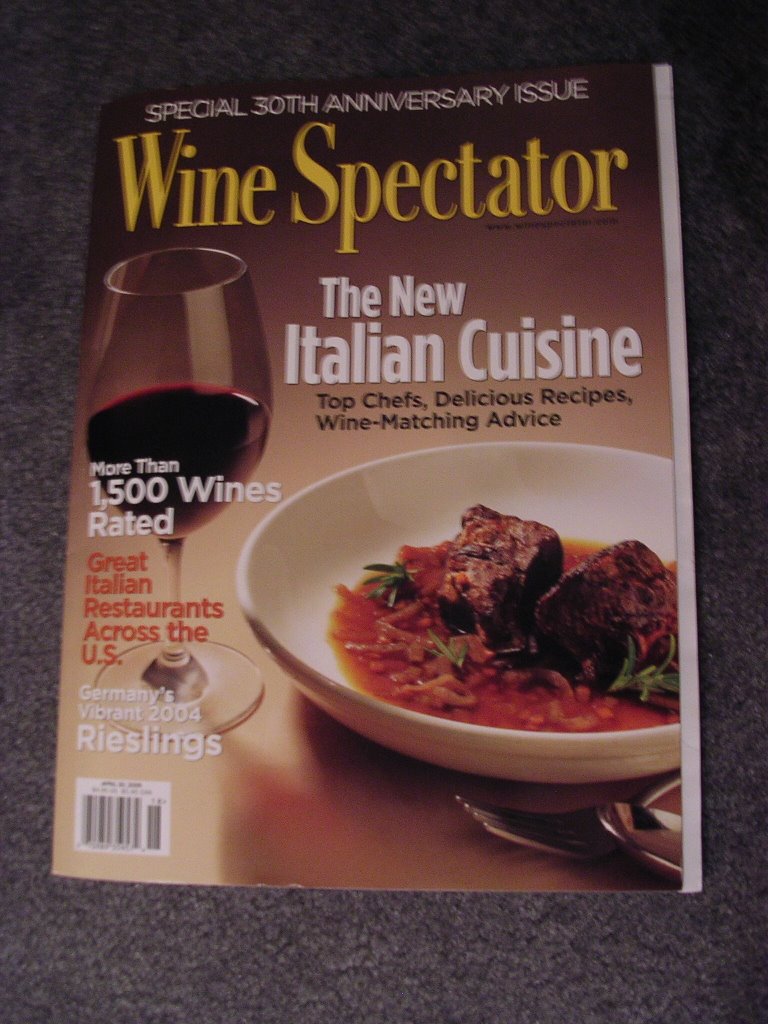
This month’s issue of Wine Spectator features an article by John Mariani entitled “Old Meets New in Philadelphia.” According to the article, Philadelphia’s diverse neighborhoods are giving rise to some very personalized restaurants. Here are a few highlights:

  • Mariani focuses on four of Philadelphia’s finest: Barclay Prime, Bliss, Gayle and Striped Bass. And yes, he mentions BP’s infamous $100 American Wagyu cheese steak, which comes with (as he says) a “slab” of foie gras and a half-bottle of Veuve Clicot.

  • Mariani also gives a shout out to Farmicia, Estia, El Vez and Amada (an authentic tapas bar I’m looking forward to trying).

  • The article laments the cost of wine in some of the profiled restaurants. Mariani lays most of the blame for this on Pennsylvania’s restrictive state-controlled wine distribution system. I am glad Mariani gave the cost issue some attention. However, I think it needs to be put into context, which will do in a later post.

  • Mariani mentions having a glass of 2002 Mark West Pinot Noir Russian River Valley ($13) at Striped Bass, though it’s not clear whether he liked it. I recently had this wine (for less than $13 a glass, I believe) at two other Stephen Starr restaurants—Washington Square and The Continental at 2nd and Market—and I enjoyed it. I haven’t had enough of this wine to be able to write anything thoughtful about it; the PLCB will not be getting any more in (though it’s not clear that they ever really had any available for consumers) and the winery told me it’s all gone. I recommend hitting one of these Stephen Starr restaurants and trying a glass while they still have some left. My only advice is to ask them to put it in the proper glass. The Continental, unfortunately, served this wine in a chardonnay glass and it never had a chance to open up.

In addition, Wine Spectator’s feature article, “The New Italian Cuisine,” profiles, among others, Philadelphia’s chef Marc Vetri of Vetri Ristorante for his innovative approach to Italian food. Also, Chef Vetri shares his recipe for Asparagus Crespelle with Balsamella Sauce.

Read More....