Showing posts with label Bordeaux. Show all posts

May 21, 2007

The 2007 Philadelphia Wine Festival Wrap-Up

Chateau Margaux 2001

Belated congratulations to the PLCB and Philadelphia Magazine for successfully hosting the 2007 Philadelphia Wine Festival. This year’s festival had around 40 fewer vendors and was a little more expensive than last year. However, the festival’s central location at the Mariott Hotel in Center City, the food provided by DiBruno’s (including the quince paste covered cheese and the bruschetta with freshly-cut prosciutto) and the never-ending courtesy cups of spring water provided by Panna were all improvements that helped to make this year’s festival better than the last.

Here are some of the notable wines at the festival, with a few thoughts and surprises along the way.

The First Growth Bordeaux

This year there were three Bordeaux at the festival, all of which were First Growths: Chateau Haut Brion 2001, Chateau Margaux 2001 and Chateau Mouton Rothschild 2003. First Growths are considered to be among the best wines in the world. If you’re a wine enthusiast, it’s important to taste First Growths because they are the wines that Cabernet Sauvignon producers all around the world look to as their benchmark. Though young, these three wines drank like heaven and were not to be missed.

Chateau Mouton Rothschild 2003

--Chateau Mouton Rothschild 2003 (PLCB No. 20296, $312.39): Aggressive, enamel-stripping tannins, but powerful, rich blackberry and cherry flavors lie underneath waiting to emerge; too young to be approachable now, but a treat to preview nonetheless.

--Chateau Margaux 2001 (PLCB No. 19342, $169.29): Flowery nose; softer and inviting; complex and nuanced structure of cassis, plum and dark berries systematically unfolding through a long finish.

--Chateau Haut Brion 2001 (PLCB No. 20098, $170.19): Grand and opulent; signature dark berries, cherries and spice; calculated and balanced structure with an endless finish.
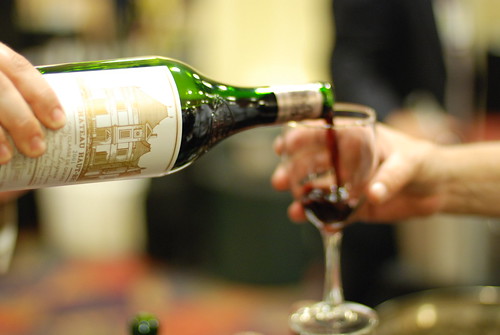
Chateau Haut Brion 2001

The First Growths, though, highlight an important issue about the festival’s pricing structure. Like past years, this year’s festival employed a two-tiered pricing system: the VIP Tasting, which cost $225 and began at 6:00 p.m.; and the Grand Tasting, which cost $125 and began at 7:30 p.m. In addition to getting an hour and a half head start, the VIPs also got to experience special Showcase wines at most of the tables, including all of the First Growth Bordeaux. The Grand Tasters, however, did not.

The two-tiered system is a double-edged sword. On one hand, it opens the event up to more people than festivals with one-tiered pricing systems such as this year’s Wine Spectator’s festival, which charged a flat $200 for everyone. On the other hand, one of the main reasons to go a wine festival (if not the main reason) is to taste the cream of the crop, wines you normally wouldn’t buy. That means the First Growths. To be fair, there were plenty of exciting wines at Philly’s festival for the Grand Tasters to enjoy. But it’s unfortunate that these three important wines were not poured for the Grand Tasters.

The Italian Wines

Italian wine lovers flocked to the Gaja table, which featured two wines: the Gaja Barbaresco 2001; and a Super Tuscan, the Ca’ Marcanda Magari 2004. The full-bodied Barbaresco had wonderfully soft tannins with notes of lilacs, strawberry and blackberry, while the Super Tuscan presented rich black currants, spice and a silky, round finish.
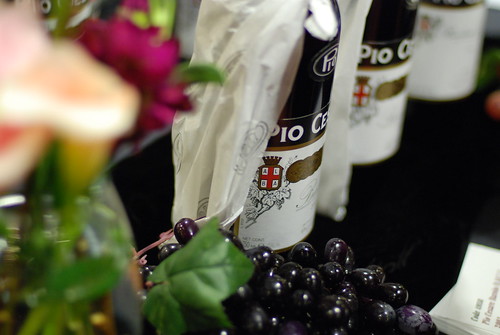
Pio Cesare

Directly adjacent to the Gaja table was Pio Cesare, which featured a Barolo D.O.C.G. 2001 (PLCB No. 4958, $49.99); and a Barbaresco D.O.C.G. 2000 (PLCB No. 23912, price not available), among others. The Barolo, while still a little closed off, was rich, silky and lingered for minutes. The Barbaresco had smooth tannins and revealed dried plum, earth and spice.

The Pennsylvania Wines

The Philly Wine Festival is always a great opportunity to check in with two local wineries, Blue Mountain and Chaddsford. Each winery produces a Meritage (sounds like heritage), an American version of a Bordeaux, both of which I’ve always found to be somewhat challenging. However, Blue Mountain and Chaddsford presented wines at this year’s festival that were exciting and surprising.
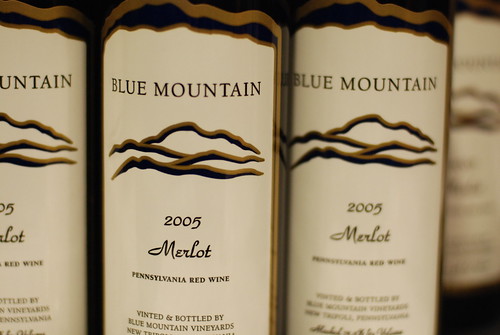
Blue Mountain Merlot 2005

The wine Blue Mountain presented that piqued my interest was its 2005 Merlot. What’s exciting about this wine is that it is varietally correct. Don’t dismiss all Merlot because of one line of dialogue in Sideways, folks. If Merlot is not overly corrupted by the winemaker, it can taste and smell similar to Cabernet Sauvignon, which includes having Cab’s signature fingerprint of green peppers on the nose and palate. And Blue Mountain’s 2005 Merlot has that classic green pepper aroma and taste. It’s refreshing to see that Blue Mountain has the courage and skill to allow Merlot to be itself. Blue Mountain’s 2005 Merlot has not yet been formally released, but if you’re interested, you may still be able to snare a bottle of it at the Blue Mountain store in Reading Terminal Market. It has an $18 dollar price point.

The two Chaddsford wines that were the most interesting were the 2004 Due Rossi and the 2005 Pinot Noir. The Due Rossi is a 50/50 blend of Sangiovese and Barbera. This wine showed surprising structure and complexity with layers of wet earth, red berries, tobacco and coffee. The Due Rossi’s price point is in the $25 range. Chaddsford takes a subdued Old World approach in crafting its 2005 Pinot Noir. The nose did not have the intense fragrance of unswept barn and dried rose petals that is characteristic of Old World style Pinot Noirs, but the wine did have a welcomingly delicate and subtle palate.

The California Wines

PLCB Chairman Patrick J. Stapleton III may not have been a wine enthusiast prior to becoming Chairman earlier this year, but he apparently knows his stuff now. Shortly after arriving at the festival, Chairman Stapleton made his way to the Silver Oak table, where he enjoyed the Silver Oak Napa Valley Cabernet Sauvignon 2002 (PLCB No. 011663, $99.99).
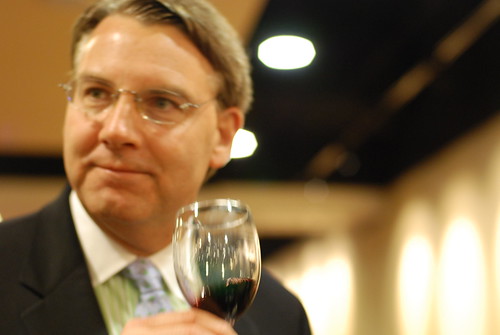
PLCB Chairman Patrick J. Stapleton III

The nose on this wine was intense and evoked a very specific smell I experienced every August in my youth when my family and I would go camping in Bedford County—dense bramble and meadow after an early evening rain. But the palate—while full of the Silver Oak's familiar rich oak and dense, dark fruit—lacked some of the nuances of the 2001.
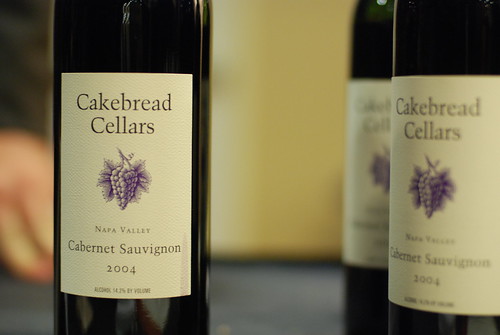
Cakebread Cellars Cabernet Sauvignon 2004

It’s hard to find a California Cab as plush and as fat as a Cakebread. Its 2004 Cabernet Sauvignon (PLCB No. 11705, $55.99) is no exception. A blend of 87% Cabernet Sauvignon, 12% Merlot, 1% Cabernet Franc, this soft and chewy wine was bursting with rich dark fruit, spice and caramely oak. It’s not the shyest of pours, to be sure, but that’s part of the fun.

There was another enjoyable Cab at the festival that had an impressive flavor profile for its price point. But because I have other plans for this wine, I’ll save the discussion for another day, closer to the end of the month.

Again, cheers to the PLCB and Philadelphia Magazine for hosting a successful event. For more pics, go to the 2007 Philly Wine Festival set on my Flickr page.

Read More....

March 03, 2007

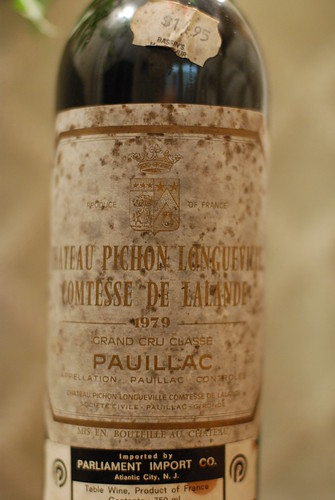
Chateau Pichon Longueville Comtesse de Lalande 1979 (Pauillac)

Chateau Pichon Longueville Comtesse de Lalande 1979 (Pauillac)

The year the grapes for this wine were harvested was an interesting year. Revolution in the Middle East led to an energy crisis, The Police’s Roxanne was making its way to No. 32 on the Billboard charts and the U.S. Mint introduced the Susan B. Anthony dollar.

It was 1979.

I was eight years old then, and all I cared about was Star Wars and pizza. A lot can change in 27 years. And wine can be a fun way to measure those changes if you have the right bottle.

A good friend of mine is an antiques dealer, and in the not-too-distant past he picked up a few lots of mixed bottles of wine at an estate auction. From what I understand, the lots included an impressive collection Bordeaux. He had drunk almost all of the Bordeaux by the time I got the chance to see the wine, including a bottle of 1982 Chateau Lynch-Bages. He was watching the TV show Alias when someone on the show mentioned the ’82 Lynch-Bages, so he uncorked it. He didn’t know that 1982 is a legendary vintage for Bordeaux. He didn’t know that Lynch-Bages is a respectable Fifth Growth chateau or that Robert Parker rated its 1982 offering an impressive 94. For him it was more of an Alias experience than a Lynch-Bages experience—he just thought it was cool that he was drinking the same wine that was mentioned on his favorite TV show.

When I met him to go through the remainder of his stash, I spied a 1979 Pichon-Lalande still left in the box, so I liberated it. You may recall the episode of the Sopranos in which Tony and Christopher heist several cases of wine. The wine they stole from the van was the ‘86 Pichon-Lalande, which Parker scored a 94 in 2003. The ‘79 Pichon-Lalande, though, was no slouch—Parker includes it among his discussion of important ancient vintages for this chateau, calling it a “top-notch” effort and scoring it a 90.

I didn’t have high hopes for this wine, to be honest. There was no information about how it was stored all these years. Plus, although Parker said it was “fully mature” and suggested it would last until the end of 2007, I had read elsewhere that it was past its prime.

Chateau Pichon Longueville Comtesse de Lalande 1979 (Pauillac)

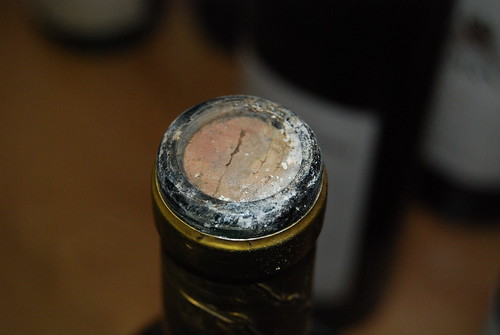
I knew I was in trouble as soon as I peeled the foil off the cap. Mold. Further inspection revealed that the top of the cork was also wet.

“Damn,” I thought, “not good signs.”

Chateau Pichon Longueville Comtesse de Lalande 1979 (Pauillac)

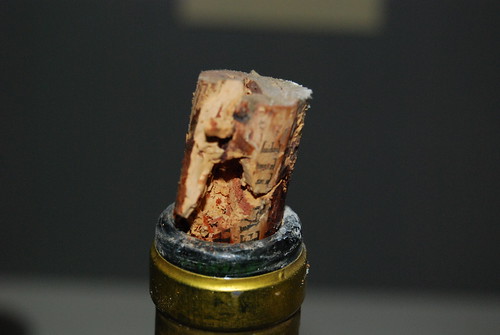
It only got worse. As the cork was about half-way out of the bottle, it started to crumble and tear in half. At this point, I pretty much knew it was over. Still, I removed the rest of the cork, wiped the mold off the lip of the bottle, poured the wine and let it breathe.

Chateau Pichon Longueville Comtesse de Lalande 1979 (Pauillac)

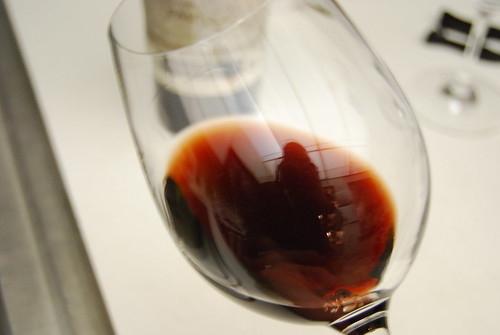
While I waited, I tilted the glass and held it above the white counter-top. The wine had that signature brown hue at the edge that you only see with older clarets. It was beautiful. I soaked up as much of the color as I could, realizing that this would probably be the only rewarding part of the experience.

Eventually, I swirled the glass, drew it up to my nose and took a deep whiff. I could identify the smell immediately; it was unmistakable. But even factoring-in my low expectations, it was heartbreaking: feces and disinfectant. After a while the smell mellowed into that of a wet basement. And that’s where it stayed, even into the next day. The subtleties of lush fruit and soft tannins the wine was supposed to reveal were nowhere to be found. All that was left on the palate was vinegary acid and the feeble hint of black currant—a faded echo of what this wine perhaps once was or what it could have been.

Tainted or not, the one thing this wine delivers is perspective about how far we have come in a quarter of a century. These days, a crisis in the Middle East is affecting the cost of energy, The Police just played Roxanne at the Grammys and the U.S. Mint is trying to push a new dollar coin. Oh, how times have changed. I don’t know about you, but all of a sudden I’m the mood for Star Wars and pizza.

Read More....

January 27, 2007

Chateau Picard 2003 (Saint-Estèphe)

Chateau Picard 2003 (Saint-Estephe

Alright, I’ll admit it. I bought this wine to satisfy my inner geek. What can I say—resistance was futile.

Fans of Star Trek: The Next Generation will recall that Chateau Picard was the fictional 24th Century red wine estate in La Barre, France owned and operated by Captain Jean-Luc Picard’s brother. The wine was featured in several ST:NG episodes and movies. At the “40 Years of Star Trek: The Collection” auction held in October 2006, two empty bottles of the 2267 vintage of Chateau Picard, which were used as props in the 2002 film Star Trek: Nemesis, sold for $6,600. Talk about wine futures….

The real Chateau Picard is located in Saint-Estèphe and was classified a cru bourgeois in 1932. Mähler Besse purchased the property in 1997 and modernized the equipment. The property grows Cabernet Sauvignon (85%) and Merlot (15%).

On the nose: The nose is not all that fragrant, though you can detect light notes of graphite, spices and green peppers.

On the palate: Typical of wines from Saint-Estèphe, the acid in this medium-bodied red is fairly high, and the tannins are not too far behind. The Merlot seems to restrain some of the tannins in the mid-palate, but eventually they boomerang back to claim the finish. The cherry fruit flavors are fiercely tart and subdued. Sadly, not as elegant or as refined as you would expect from the family of a decorated Starfleet Captain (perhaps the 2267 vintage will be a little more supple). But even without the help of a Tricorder, you may be able to detect a few faint notes of chocolate and nutmeg lurking in the background.

On the wallet: I tend to enjoy acid and tannins in my wine. And I do prefer Picard over Kirk. So this wine is fun for me, at least it will be for a bottle or two. But unless you’re really into tannins, acid and/or bald Starfleet Captains, $23.99 may be a bit steep for this sharp, little gum-stretcher.

On the table: This wine screams for food. Stick with rich meats or cream-based dishes. Avoid pairing with tomato sauces and Klingon cuisine.

Read More....

June 20, 2006

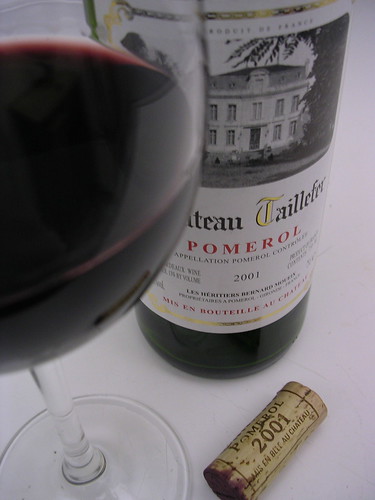
Chateau Taillefer 2001 (Pomerol)

Chateau Taillefer 2001(Pomerol)

Chateau Taillefer is one of the largest producers in the Pomerol region, which is the smallest red wine region in Bordeaux. Merlot is the dominant variety in Pomerols, which generally means (1) they have a higher alcohol content; (2) they have softer tannins; and (3) although top Pomerols evolve well in the cellar, most are ready to be drunk early. Robert Parker notes that restaurants dig Pomerols specifically because they come ready-to-drink.

The PLCB boasts that Wine & Spirits gave this wine 90 points. To borrow a phrase from one of my good friends, I’d take that with a pillar of salt. Parker doesn’t have much love for this chateau. Although he lists Taillefer as a “notable” Pomerol property, he feels that, because it is one of the larger properties, it should be making better wine.

On the nose: Red berry and peppery aroma.

On the palate: The 2001 Taillefer is a blend of 75% Merlot and 25% Cabernet Franc, both of which are supposed to make this wine approachable at an early age. This wine, however, may still be too young to drink. It starts off a bit thin and watery. As it opens up, some red fruit and light raspberry finally emerge, followed by hints of spice, new oak and chocolate. The tannins could be softer and the acidity should be a little lower, but these rough edges are the privileges of youth. There’s not much of a finish. This wine shows some promise; it would be interesting to see how it matures in 3 to 5 years.

On the wallet: This wine is one of the PLCB’s Chairman’s Selections, a designation apparently meant to highlight the PLCB’s “buying power.” The PLCB claims this wine normally goes for $44.99, but thanks to the PLCB you can drive this baby home for the low, low price of $19.99. However, the $25.00 “savings” should not be the measure of whether this is a good deal; the wine needs to stand on its own at $19.99. Pomerols are supposed to come ready-to-drink, but this wine is still a bit too young. Plus, it’s not as gentle or as fruity as a Pomerol should be, which is surprising given that Cabernet Franc is in the mix. A little time may resolve these issues, but you may not have the patience to cellar something from this chateau. This is a good Bordeaux and it has potential. But $19.99 may be slightly ambitious for a wine that is not quite ready to come out of the oven.

On the table: Steak and burgers.

Read More....

May 04, 2006

Philadelphia Wine Festival 2006 Wrap-Up

Congratulations and thanks to the PLCB and Philadelphia Magazine for successfully organizing this event. The place was packed. It was challenging at times to make your way down the aisles and to the tasting tables. Even though I arrived early, some of the more popular wineries were already starting to run out of wine. Given the ground I was hoping to cover, I didn't have time for detailed note taking. So, for what it’s worth, here are a few quick, skeletal thoughts on the wines at the festival that made my Greatest Hits List:

  • Silver Oak Napa Valley Cabernet Sauvignon 2001 ($99.99). I had been looking forward to enjoying Silver Oak ever since I learned it was participating, and their wine delivered in a big way. Ponderous. The nose included light notes of cloves and oak. Rich caramel on the palate. Long finish.

  • Chateau Palmer 2003 (Margaux) ($147.99). Palmer is a Third Growth Bordeaux. For this reason alone it should have been on everybody’s dance card. Spicy nose. Medium body. Dark fruit. Firm tannins, but well balanced and smooth.

  • Stag’s Leap Wine Cellars Fay Cabernet Sauvignon 2002 ($74.99). Lavender and violets on the nose. Dark berries on the palate. The warm tannins are the centerpiece of this wine—soft, silky and seductive.

  • Cakebread Cellars Cabernet Sauvignon 2003 ($53.99). This was a popular table, as I suspected it would be. Even though I managed to elbow my way to Cakebread’s table by 6:40, I watched them pour the last of the Cab right after I had my sample. Dark berry and chocolate flavors. Peppery accents.

  • Heitz Cabernet Sauvignon Martha’s Vineyard 2001 ($134.99). According to the program, this wine was reserved for the VIPs, so I feel fortunate to have sampled this gem. I was impressed that Kathleen Heitz Myers, the President of Heitz Wine Cellars, actually was onsite pouring the wine. Very floral nose with notes of cloves. Dark fruit and spice. Balanced tannins.

  • Joseph Phelps Cabernet Sauvignon 2003 ($50.29). Plum and dark berry. Finish is long and complex with a savory / umami taste.

  • Best Wine: Unquestionably, the Champagne Krug Grande Cuvee NV ($152.99). Stunning. Fresh, crisp and dry. Bold notes of roasted nuts with light buttery accents. Very complex and elegant. Worth the price of admission even if this would have been the only wine in the room.

Other Highlights:

  • PA Wines. The two Pennsylvania wines I sampled were impressive and surprisingly drinkable. I tried Chaddsford’s Merican 2001 ($29.09) and Blue Mountain’s Blue Heron Meritage 2003 ($22.49), both of which are American versions of Bordeaux. Head-to-head, Chaddsford edges-out the Blue Mountain on taste. But the price points for these wines are bafflingly high, especially since there are numerous true Bordeaux wines available that are cheaper and more refined.

  • Coolest Wine Name: Oculus. Part of the compelling “Wines of Canada” table. I know, oculus is Latin for eye and it’s the name of the opening in the dome of the Pantheon. But, come on, it’s got a heavy metal ring to it. Probably not the most polished wine in the room (a bit jammy, actually), but you felt like a bad ass drinking a wine named Oculus.

  • The Food. The cheese and fruit disappeared quickly and the lines for the hot hors d’oeuvres were too long. Toward the end of the evening, though, I wandered to the side patio where the line at the Canadian foie gras table was curiously short. I soon found out why. This pate was intense, overwhelming and unnaturally gamey, which would have been fine had the experience stopped there. It didn’t. The aftertaste, literally, was nauseating. And it only got worse and more intense the longer you went without rinsing your mouth. It may be a while before I can partake of anything Canadian. Except, of course, the Oculus.

Final Thoughts:

  • Next year, spend the extra coin for the early VIP Tasting. You’ll have more time to enjoy the more popular wines before they run out. Plus, you’ll be treated to special selections, like this year’s infamous Joseph Phelps Insignia 2002, that are not available to the regular attendees.

  • If you plan to buy anything at the on-site PLCB store next year, do it early. Apparently, there were a lot of impulse buyers at the festival. The Silver Oak, for example, sold out quickly.

  • Normally, it would cost $715.23 to experience the seven wines on my Greatest Hits List. I experienced all of them, plus many others, for only $95. Not too shabby.

Read More....

January 24, 2006

Chateau Plagnac (Medoc) 2000

This is a hard Bordeaux. It starts off with a hint of spice, but quickly turns tart and vegetal. Very short finish. It does soften a bit after it airs for a while, but not enough to salvage the experience. This wine may be at the end of its maturity; Parker suggests drinking wine from this chateau within the first 6 years of the vintage. That may explain why this vintage now appears on the PLCB store shelves. If it was reasonably priced, I might be more forgiving. But with the PLCB's 30% mark up, the 18% Johnstown Flood Tax and 7% sales tax imposed in Philadelphia, this wine tops out at over $18.00 a bottle. Sorry. At that price, this wine is not worth it.

Rating: C-

Read More....