January 06, 2007

A Few Thoughts on Newman’s Resignation from the PLCB

You’ve all heard by now that Jonathan Newman resigned from the PLCB. You can find the full text of his resignation letter here on the Clog. As the Philadelphia Inquirer reported on Friday, wine enthusiasts are worried that Newman’s departure will affect the selection of wine we have enjoyed over the past few years. Actually, this worry existed prior to Newman’s departure, when the CEO position was created and took the statutorily-mandated day-to-day operations away from the Board. But now that Newman has resigned, the worry seems more real and the consequences more imminent.

Many people are taking a wait-and-see approach. But I'm less optimistic. There are signs already that things may get worse.

Part of it is understanding what we’ve lost. Everyone applauds Newman for making PA a more wine-friendly state. But what’s interesting is how he did it. Newman managed to take the one thing that made the selection of wines in PA abysmal—having to fill the shelves of 643 state-owned stores—and actually used it to expand the selection of wines—leveraging the state’s buying power to get great deals on quality wines. He transformed part of an antiquated bureaucracy into a sword for consumer advocacy. Such out-of-the box thinking is rare, even in the private sector. Sure, things weren’t perfect, but he made things better than they used to be.

I don’t know much about Conti. However, I do know that he has been opposed to privatizing the state-run system—not exactly the resume of an advocate for the PA wine consumer. So, I don’t have much confidence that he will pick up the baton of progress that was stripped from Newman’s grip, or run with the vigor and passion Newman displayed. I look forward to Conti proving me wrong.

Other clues that there’s a less-than-bright future ahead for wines lovers in PA can be found in statements the PLCB has made. The Chairman’s Selection program was one of Newman’s most successful innovations. Although the new chair, P.J. Stapleton, says that they “have a commitment” to the program, he said it is “hard to say at this point if there will be an increase or a decrease or if the quality will change.” The fact that Stapleton suggests that the quality could be in jeopardy and admits that the choices could decrease is not encouraging.

Also, Stapleton took a shot at the Chairman’s Selection program, saying “a lot of wineries in California and elsewhere looked at Pennsylvania as an opportunity to rid themselves of wine” they didn’t want or couldn’t sell. I’m not surprised by this and, in fact, it’s something I’ve always suspected. But, to be fair to Newman, this isn’t so much a problem with the Chairman’s Selection program as it is an inherent flaw in the state-run system that the Chairman’s Selection program simply couldn’t fix—having to fill the shelves of 643 stores across the entire state. If they only had to stock a few stores’ shelves, they would have the luxury of being more selective. Stapleton, who is not a wine lover, seems to suggest by his criticism that he believes the program should be reduced. But taking choices away from PA wine consumers, without something to counterbalance it, only seems to put us back where we started before Newman took the helm. We’ll see how it plays out, but these statements aren’t delivering the comfort or inspiration the PLCB should realize it needs to deliver right now.

I’d like to finish this post with a toast to former Chairman Newman. In honor of his innovations, I’ll raise a glass of one of his Chairman’s Selections—the 2003 Chateau Lascombes, an elegant Bordeaux from the Margaux region: Thank you for making Pennsylvania more of a wine-friendly state, and good luck with your future plans. And, hopefully, there will be a wine this enjoyable on the shelves the next time you visit a PLCB store. Cheers.

Read More....

January 01, 2007

New Year’s Eve 2006, Part I — A Champagne Tasting

Champagne Bouquet 2
A few years ago my wife and I hosted a Champagne tasting at our house for New Year’s Eve and it was a blast. So, we thought we’d try it again this year. This was a blind tasting—all of the wines our guests sampled were in randomly-numbered brown paper bags. Nobody knew which Champagne they were tasting when they recorded their comments. I picked five Champagnes for the tasting, most of which had received some sort of press over the past few weeks. Of the five selections, four were Champagnes and one was a California Sparkling wine. All of the wines were non-vintage. Because rosé Champagnes are all the rage this year, two of the four Champagnes we tasted were rosés. The results of the tasting were interesting.

Billecart-Salmon Brut Rosé NV

The two rosé Champagnes were the Billecart-Salmon Brut Rosé NV ($70) and the Nicholas Feuillatte Brut Rosé NV ($34.99, PLCB No. 029573). My friend Kez, who lives in France, highly recommended the Billecart-Salmon in the comments to a previous post. Slate recently called the Billecart-Salmon “arguably the best-value nonvintage rosé on the market.” I also understand it received a 90 from Robert Parker and a 91 from Stephen Tanzer of Food and Wine Magazine. Sadly, you can’t get it here in PA; a friend of mine brought it in from New York. The color was a light, salmony pink. It displayed aromas of raspberry, strawberry and minerals and was relatively acidic. The bubbles were explosive and frothy.

Nicholas Feuillatte Brut Rosé NV

Someone I trust at one of the PLCB Specialty Stores recommended the Nicholas Feuillatte. This wine received an 87 from Wine Spectator. It had the color you would expect a rosé Champagne to have. Not as acidic as the Billecart-Salmon, nor as bubbly, and many of our guests said it had a bitter finish. But it was a little fruitier, had nice berry flavors, and our guests found it to be round and soft (one even found it to be more balanced than the Billecart-Salmon).

Of the two rosés, though, most folks preferred the Billecart-Salmon. Many, in fact, picked it as their overall favorite of the evening. Although this was definitely my overall favorite as well, I was not as blown away by the Billecart-Salmon as I expected to be. These two rosés were notably different, but I don’t know whether the differences between them are great enough to justify paying twice as much for the Billecart-Salmon.

Roederer Estate Anderson Valley Brut NV

Of the three non-rosés, two were Champagnes and one was a California Sparkling wine. The very first wine we tasted was the one from California—the Roederer Estate Anderson Valley NV ($21.99, PLCB No. 007933). This wine was featured in Wall Street Journal’s December 1, 2006 Tastings column (subscription required). The WSJ’s wine critics, Gaiter and Brecher, rated it Good/Very Good but didn’t give it an amazingly glowing review (they said it had “no real depth”). Plus, as the article points out, American sparkling wines are “often less nuanced, and the bubbles sometimes seem an overlay on the wine instead of an integral part of the taste.” It was also the least expensive of the five. So, I didn’t expect this wine to leave any lasting marks. Surprisingly, though, everyone picked this American sparkling wine as their favorite non-rosé, beating out the two French offerings. Two of our guests even selected the Roederer as their overall favorite. It was light, crisp, clean and smooth, and had a nice balance between sweetness and acidity.

Taittinger Brut Champagne La Francaise NV

The wine I expected to do better than it did was the Taittinger Brut Champagne La Francaise NV ($35.99, PLCB No. 004001). Wine Spectator rated this a 91, saying it showed “elegance and finesse” and had “an understated power.” This Champagne didn’t display any flaws. It was rather effervescent and I thought it had a slightly creamy finish. But aside from that, it was rather non-descript and unimpressive.

Pommery Brut Royal NV

The last wine we tasted was the Pommery Brut Royal NV ($37.99, PLCB No. 029553). Last year my wife really enjoyed the Pommery we had, and because she had been reminiscing about it, I thought I’d throw it into the mix. I read on one of the bulletin boards that Richard Juhlin, who claims to be the number one Champagne expert in the world, rated this Pommery a 75, which ain’t good. But you didn’t have to be a Champagne expert to be offended by this bottle. Our blind tasters described its odor as “rubber gloves,” “petroleum” and “awful.” One guest gave this Champagne a two-word review that pretty much said it all: “That smell!” The fact that this was the second most expensive Champagne of the evening made it all the more disappointing.

So, what did we learn? Not much, really. After all, it was New Year’s Eve and we were doing shots of Champagne for two hours straight; it was heard to learn anything after that. But we had a lot of fun and we were among friends. And that’s what ringing in the new year is all about.

Stay tuned for New Year’s Eve 2006, Part II—Tangerine.


Read More....

December 27, 2006

An Exclusive Interview with Jonathan Newman, Chairman of the Pennsylvania Liquor Control Board

I scheduled this interview with Jonathan Newman, Chairman of the Pennsylvania Liquor Control Board (“PLCB”), weeks before the controversy erupted surrounding the rushed creation of the PLCB’s CEO position and former Senator Joe Conti’s appointment to that post. I had planned to fill our half hour discussion on December 20, 2006 almost entirely with the type of in-depth questions only a wine geek would ask, but the politics of the day could not be ignored and Chairman Newman graciously obliged.

In his first-ever interview in the blogosphere, Chairman Newman talks candidly and passionately about his principled opposition to the CEO post, the shadow it casts over the continued viability of the initiatives he spearheaded, such as the Chairman’s Selection program, and whether he will remain with the PLCB in light of Conti’s appointment. Chairman Newman also shares his thoughts on the infamous Johnstown Flood Tax, whether it is still illegal to ship wine into Pennsylvania, and what the Pennsylvania legislature should do on the issue of direct shipment. And before the interview is over, he may even have a wine recommendation or two.


Chairman Newman, welcome to PhilaFoodie. Thank you for taking the time out of your busy schedule to talk with me.

It’s my pleasure.

I know that you conducted an online chat on the eGullet bulletin board back in the day, but have you ever been interviewed on any blogs?

I have a lot of respect for blogs. I think blogs have transformed the atmosphere of communications in Pennsylvania. This is actually the first such time I’ve participated in an interview in this format, so glad to do it with you for the first time.

I’m honored, Chairman. Thank you. Before we talk about wine, I’d like to talk a little about the PLCB’s newly created CEO post that made the news last week. The PLCB voted 2 to 1 to appoint former Republican State Senator Joe Conti as the CEO of the PLCB. You opposed the appointment and expressed some strong comments about it. Why?

It was a bad day for good government in Pennsylvania. I believe in public comment and a chance for media scrutiny. There was no transparency in state government. This was a decision that was a fait accompli by the time the information was given to me. I was given the name on Monday afternoon. I was given the job description and salary amount Tuesday afternoon at 3:00 o’clock and was supposed to rubber stamp it at 10:00 a.m. on a Wednesday board meeting. I felt that, given the dynamics of the Pennsylvania Liquor Control Board, if it was appropriate to search for a CEO, a COO, or a CFO, there should have been an RFP [request for proposal], we should have hired the best consultant to see if this was well-advised. And then if it did make sense, we should have truly done a national search and found the best individual. It was a bad day for state government, and at the end of the day integrity and character mean a lot to me and I felt very strongly that this was a bad move for the PLCB and a big negative for the commonwealth of Pennsylvania. And the reason I have been at the PLCB for 7½ years, and Chairman for 4½ years, is I believe in good government, I like my job, I work hard, I feel like I’m making a difference in people’s lives. The board powers that are mandated are statutory. Board members are meant to work full-time. I put in 60, 70 hour weeks and put my heart and soul into this job and feel like I’m making a difference for Pennsylvania consumers. And I object to the process and the way this was done.

Why do you think the Governor’s office rushed this appointment?

I don’t know. I can’t guess what the intent of others would be. I certainly have read op-eds throughout Pennsylvania. Every editorial board of every newspaper in the Commonwealth is outraged. It’s been covered extensively on radio, and I know that the public is outraged by what happened. And I’m obviously disappointed that this is what it came down to. But in order to understand the Governor’s intent and what his thinking would be, you’d probably have to ask him or his administration.

Certainly, the process was not done well. The PLCB has had record profits. Our numbers are extremely impressive, and I’m proud at the kind of returns we’ve delivered for the Commonwealth. In fact, on a press release approved by the Governor’s office, dated July 10, 2006, Pennsylvania Liquor Control Board announces record sales performance. Last year for our fiscal year that ended in June, for 05/06, we contributed $80 million in profits to the Commonwealth, $315 million in taxes, $18.5 million to the Pennsylvania State Police, for enforcement, $2 million to the Department of Health for drug and alcohol programs and $4.5 million in licensing fees, returning $420 million. Board member Tom Goldsmith is quoted as saying “the PLCB’s strong sales performance benefits all Pennsylvanians.” During the past fiscal year the PLCB will have contributed more than $420 million to the Commonwealth, bringing the total to more than $1.5 billion for the past four years. Expenses have been consistent. For the upcoming year, we’ve kept our expenses very consistent. The only expenses that have changed have been those negotiated by the Commonwealth, which include the licensing discount, which was legislative and signed by the Governor, and wage and other retirement benefits. So, we’ve watched our expenses very carefully. We’re opening big, beautiful Premium Collection Stores, our sales numbers have shown record growth, and I’m proud of our accomplishments. So, as far as intent, I’d be real curious as to what the answer is.

Does the PLCB really need a CEO?

Well, I wrote the Governor a memo in October of 2005 when I first heard the discussion of whether the PLCB needs a CEO, and it was right after the legislative pay raise fiasco. And I thought it would not be consistent with government to bring in a CEO at a big salary because, first of all, it’s statutorily mandated that such a position does not exist and has not existed since 1933 with the inception of the Board. And I have, for my $65,000 salary, put, as I said, my heart and soul into it. And I have been clear to the Governor and, David, I want to be clear to you. I have said to the Governor every step of the way, written it down, and said it to his administration: I do not want a dime more, I am doing the job that I love, the salary is not an issue to me, I absolutely don’t want anything more. That has been very well documented because I felt like I was doing some good and taking the PLCB to the next level, through all my marketing initiatives, because I care, because I was making a difference.

If the position was warranted, there should have been a national search firm brought in to have a competitive RFP to make sure we get the best consultant to see (a) if it’s warranted; (b) if it’s warranted, then you do a national search and you find out the best candidate who’s out there. That’s transparency in government. Not being given the name on Monday, an amount of money and a job description on Tuesday and expected to rubber-stamp it on Wednesday. So, I don’t know that it was necessarily needed, but if a professional was brought in and they made recommendations, certainly the Board should have been consulted during the course of such a process. Such a process did not occur.

The Philadelphia Inquirer reported that Governor Rendell was surprised and saddened by your opposition, and the paper also speculated that Rendell might strip you of your chairmanship of the three-member board. Do you think that’s true and have you spoken to Rendell since then?

I have not spoken to Governor Rendell since then. When we had our conversation on Monday, I said: Governor, I have some concerns, we need to sit down and talk about this. I would become a paper tiger and not be able to get the accomplishments that I’ve done going forward. And he said: no problem, he would put it together. I had a 3 o’clock meeting with Joe Conti, and Secretary [Joseph] Martz from OA [Pennsylvania’s Office of Administration]. I expressed to them in no uncertain terms why I would oppose this and I felt uncomfortable about it. And they knew based on that meeting that I did not have a comfort level in the process that was happening.

The two ways this is being spun is that there are declining profits, and that is far from the case. I can certainly forward to you our balance sheet. We have been a cash cow for the Commonwealth. And the other [way it is being spun is] to say that I wanted this position. I was doing the job required of this and never wanted a dime more from this. It was my love of making Pennsylvania a better wine culture, of delivering value for wine customers, of making sure I looked out for the consumer in advocating direct shipping, Sunday sales, opening our stores on holidays, tastings at stores, being able to sell accessories. So, I am saddened to see the weak response due to my indignation of the process and the way this was approached. I am hoping that the process will be reversed and they will come to their senses and realize this is a bad idea.

Senator John Rafferty, Chairman of the Law and Justice Committee, is planning, so far, on conducting hearings at the end of January. Both he, Representative [Ron] Raymond and Representative [Robert] Donatucci, the Republican and Democratic Chairs of the House Liquor Control Committee, are concerned about the process. The questions are: Is it appropriate to take a Board that has statutorily-mandated responsibilities and to have the Board abrogate those responsibilities to a person, giving them day-to-day control over all the responsibilities? Is it remedied by simply saying that that person reports to the Board? If you do something like this to the Liquor Control Board, could you do it to the PUC, to the Turnpike Commission? Could you bring in people at these very high salaries, who have not been confirmed by the Senate, and give them many of these mandated responsibilities? And that’s why I’ve received so many phone calls and support from many legislators who are outraged in the process.

You mentioned a lot of the improvements you’ve made at the PLCB. Does the creation of this new CEO position or Conti’s appointment threaten to change any of that at all?

Well, I think everything is to be determined. The day-to-day responsibilities have been taken away from the Board and been given to the CEO position. So, therefore, much of my vision, like the Chairman’s Selection wine program, using Pennsylvania’s purchasing power to get great deals for our consumers, and my visions going forward, for example, I had a concept of a virtual store. A virtual store is you could go to the Internet and have access to all the products the PLCB could obtain, items typically that only restaurants could obtain, other items that we have access to. So, if you live in a neighborhood that has a small store, you would suddenly have a huge selection of products available. You could find out about varietals, ratings, wineries, regions, you could keep a library of wines you ordered, you could order those products and they would be available in your store of choice in a very short time period. I think that was something that was due and was a concept that I was working on. But given the way the Board structure sits now, I don’t know that I will have my imprimatur on the future direction. It [the CEO job description] simply says the Board will be consulted on policy and regulatory issues and that this individual would report to the Board. But there’s a five-page description of how he’s taking over all these Board responsibilities. So, I believe firmly in the things that I was doing, making Pennsylvania a more consumer-friendly state, and initiated about 20 different marketing initiatives. As it stands now, given the present structure, I think there’s a real question mark as to what the future vision of the PLCB will be. And, quite frankly, if this decision is not reversed, I will have to seriously think about what my future is going to be because I am very uncomfortable the way things were done, and if the process is not reversed, I have serious reservations going forward.

You mentioned that Senator Rafferty plans to conduct hearings at the end of January. Do you think it’s possible that a lawsuit would be filed?

I don’t know who would file that lawsuit. I haven’t seen that yet, but I know that Senator John Rafferty is somebody who stands for good government. And he wrote me a letter that he sent to the other board members, also signed by a Republican and Democratic state representative, saying: listen, there’s been no chance for dialogue; we’ve had a good relationship between the PLCB, the Administration and the legislature; consult us; let’s do this in an open process with transparency in government; we’re very uncomfortable about the process. I’ve heard from Republican and Democratic legislators equally expressing outrage. I hope the legislature follows through on this and makes good on the situation, and I certainly would encourage the media and citizens to look into this process and see if this is what they believe state government is about.

I’d like to switch gears now to talk about your recent holiday purchasing trip to California. I understand that you are calling this the most successful visit ever to California. Why?

I am really proud of the Chairman’s Selection wine program. It’s something that has dramatically changed the way Pennsylvanians purchase wine. The Chairman’s Selection program has now exceeded $70 million in sales. And, essentially, the way the Chairman’s Selection program works is wineries never want to discount their product, but sometimes, for whatever reason, market forces, there’s a ton of product in Australia right now, and when wineries have to discount their products, what they typically do is sell it to restaurants or on cruise ships where there isn’t a perception that they are discounting their product. So, if a winery wanted to selectively discount their product in a market like New York and discount it to Sherry-Lehmann, if Zachys and Morrell are already paying full freight and they see that a winery is discounting to Sherry-Lehmann, that winery has alienated themselves forever with other retailers. But since Pennsylvania is a monopoly, I found a way of using Pennsylvania’s purchasing power to deliver great deals for consumers. This has been written up nationally in publications like the San Francisco Chronicle, which said Pennsylvania’s arguably the best place in America to buy fine wine. When I went out to California, the buzz is out there right now of what the Chairman’s Selection program is doing to create excitement among consumers, so wineries see it as a marketing investment in the Pennsylvania market to get their brands well-known. They don’t feel that they are hurting their products because I am including them in a program where we prioritize those brands in the stores, our employees have tasted those products, we’re creating excitement for their brand names, and since we’re a monopoly, we are in no way harming the marketplace nationally. And now, when they have really good products, they will call me and certainly when I go out and visit, that’s the opportunity, face-to-face, to get the job done.

And the recent trip to California is really amazing. The products have all been depleted and the way Chairman’s Selection products move is it creates a treasure hunt atmosphere. And with the inventory that was purchased, between the taxes and everything the Commonwealth will collect on this, we will have made $2.5 million based on these purchases. The wine lovers respond with their pocketbooks and the Chairman’s Selection codes quickly move, so people realize that there is a lot of excitement. That’s what every retailer wants to do—is to have great products in their stores, to drive products in their stores, to move through their inventory quickly. We do not take a larger mark-up on the Chairman’s Selection products than we do on any other product, so we don’t necessarily have an incentive to just sell Chairman’s Selections as opposed to other items.

The reason I do it is I feel like I’m making a difference with people. When people sit down at the dinner table, they have a great bottle of wine. I reject over 70% of the wines that are presented to me, and the only wines that are presented to me are wines that show cost-savings, don’t have bad press, and wines that have a good taste profile. So I want to keep the integrity of the program, to work hard to deliver profits to the Commonwealth.

And, at the same time, in South Eastern Pennsylvania, we would bleed a lot of business to Delaware and New Jersey, a lot of people would go out of state to purchase product. We are winning the battle of boarder bleed. We have had, three years in a row, over 7% growth. We are on track this year for a fourth record year where we have not seen this kind of sales growth since World War II and the reason is because of the Chairman’s Selection program; because we’re reinvesting in our stores, creating big, beautiful Premium Collection Stores with a great shopping experience; having a wide selection of wine and spirits; training our wine personnel, trying to take them to the next level. A lot of excitement has been created. I’d like to keep this moving forward and that’s why the recent events concern me.

Are there any wines that stand out from the recent California trip?

Yeah, there are so many. The Freemark Abbey Sycamore, which is a wine that typically sells for $55. This is from the great 01 vintage, $19.99 [PLCB No. 011702]. The Freemark Abbey Bosche, a wine that sells for typically $65.00, $29.99 [PLCB No. 011701], and that has a 95 rating from a prominent publication. The Freemark Abbey Bosche, just a beautiful bottle of wine. When I was there, I met with the people who purchased Arrowood as well, and we have some great Arrowood Chardonnay coming in. Grand Archer Cabernet, the [01] vintage, at a crazy price point of $8.99 [PLCB No. 011551].

Freemark Abbey Sycamore Cabernet Sauvignon 2001Beringer Private Reserve Cabernet Sauvignon, 1996

David, one of the things that I’m proud of is the high quality of these wines. Let me give you an example. One of my purchases was the 1995 Beringer Private Reserve Cabernet, which typically sells for about $100 to $110 in the marketplace. I sold it for $59.99 through the Chairman’s Selection program. There was a recreation of the Judgment of Paris, a tasting that Steven Spurrier did in 1976. In this new tasting, there were great Bordeaux, First Growths, California cult wines, and the winner was a Chairman’s Selection—the 1995 Beringer Private Reserve. Now, while that’s sold out, I just brought in from the California trip the 1996 [PLCB No. 011302], 1997 [PLCB No. 011307], great vintage, 1999 [PLCB No. 011238] and the stellar 01 vintage [PLCB No. 011685], line priced at $59.99. What a great opportunity for Pennsylvania consumers to try four different vintages of this amazing bottle of wine at that kind of price. But you know what, I’m a value shopper, and I purchase products everywhere from $7.99 to hundred dollar bottles of wine. Just an amazing selection. So, in the past, if you went to our stores, you might see ten Chairman’s Selections at one time. Now, you’re going to see 40, 50 different Chairman’s Selections during the last two weeks of December. Just an exciting time to be a wine shopper in Pennsylvania.

How did the PLCB snare 403 cases of the 2004 Clos des Soutyères from Les Verrières? Only 1,000 cases of that were made.

You know, that’s the difference in instilling in our wine buyers the fact that we’re a monopoly, that we’re the largest purchaser of wine and spirits in the United States, the largest purchaser of California and Italian wine in the world. And using our purchasing power to drive great deals with the wineries. Because, you know what, David, it used to be business as usual. A supplier would come in and you would simply list their wine and those were the wines available at the store. I try to bring in a good team of wine buyers to get great deals on products, to have people really fighting as consumer advocates.

Listen, we still have a long way to go. The taxes are too high. The Johnstown Flood Tax is something that should be visited by the politicians to find a way to make Pennsylvania prices more competitive. I’ve looked at concepts like flexible pricing because certainly our competition in Delaware and New Jersey uses loss leaders to lure in customers and then have high mark-ups on many products. We need to be more entrepreneurial. We need to hunt down these values. That’s where you make a difference in life. Fighting for the consumer, wanting to make a difference in peoples’ lives and being fiscally responsible at the same time. And I really think that we struck that balance during my 4½ year tenure as Chairman.

I’d like to talk a little about direct shipment. Pennsylvania’s statutory and regulatory scheme used to prohibit out-of-state wineries from selling and shipping directly to consumers, hotels and restaurants, while allowing in-state wineries to do so. The Cutner v. Newman decision out of the Eastern District of PA declared Pennsylvania’s statutory and regulatory scheme unconstitutional on Equal Protection grounds. However, the decision appears to enjoin the PLCB from enforcing those laws only to the extent that they are applied differently with respect to in-state and out-of-state wineries; it does not appear to enjoin the PLCB from enforcing them altogether. So, what is the state of the law right now on direct shipment? Are all wineries prohibited from selling and shipping directly to consumers, or is it the other way around—are all wineries permitted to sell and ship directly to consumers?

David, that’s a great question. I’m going to give you a detailed answer to it. Of course, I put aside a half hour and this will be the last question, but I want to give you my very candid thoughts on the topic of direct shipping.

Let me tell you first why I support direct shipping. I think we owe it to the Pennsylvania consumer to give them as many choices as possible. And as much as we are stocking the Wine and Spirit stores, especially the Premium Collection stores, with an amazing selection, there is no retailer in the country that can stock the tens of thousands of wines that are available all over the country. And consumers, especially wine drinkers, want a wide range of products. So, if somebody wants to pay the taxes and have wine shipped to their home, I don’t have any objection to it. And let me tell you the reason. I have four children. I have an 18 year old. I am nervous about everything he does and of every vice that’s out there right now. The one concern I don’t have is that he’s going to be purchasing fine wine on the Internet. So for people to think that this is about wine getting into the hands of minors, it’s a misnomer. The concept is there truly has to be an adult signature required. If not, the shippers and the people who are sending it would suffer very strong penalties, a loss of their reputation, serious fines. And what’s happening right now? People are shipping via brown boxes and it’s being left for minors. So, since there isn’t a vehicle for tax collection, and an outlet for doing this legally, people are bootlegging it, they’re are shipping it in brown boxes and it is getting into the hands of minors, and that is the wrong thing. We work too hard at the PLCB in documenting at the stores, making sure it’s not getting into the hands of minors. And you could set up a system where you are checking to make sure that an adult signed for it and it’s not just being left on the doorstep for kids.

Second is the question of tax revenue. Since people are shipping it in brown boxes, there is zero tax collection. So, in fact, I believe this could be incremental revenue to the Commonwealth of Pennsylvania. If people are willing to pay the taxes, want to have it picked up at their home, God bless them. Let them pay their taxes, have the product shipped to their home.

As far as what the state of law [is] in Pennsylvania right now: there is no law on the books. And the law has been found unconstitutional. So, shortly the legislature is going to have to take up this issue and deal with it head-on because the law has been found unconstitutional. I know that wineries are very nervous shipping into Pennsylvania right now; nobody knows what the state of the law is. But clearly there has to be legislative action shortly.

Where is Rendell’s proposal?

I don’t know. I haven’t seen anything on it recently.

Chairman, I really appreciate you taking the time out of your busy schedule to talk with me here today.

Thank you.


Read More....

December 23, 2006

Bar Ferdinand

Bar Ferdinand

History has hosted some classic rivalries: Mozart and Salieri, Edison and Tesla, Coke and Pepsi. Bar Ferdinand and Amada may not be rivals per se (at least nothing beyond your typical marketplace competition). But you almost can’t talk about Bar Ferdinand without comparing it to Amada. Both are Spanish tapas bars, one of the hot trends in Philly’s restaurant scene. Amada, considered by many to be the yardstick by which other tapas bars are to be measured, was at the forefront of this trend. Bar Ferdinand opened shortly thereafter. So, comparisons are inevitable. And much like the classic rivalries noted above, there are strong opinions on both sides of the aisle.

Bar Ferdinand Dining Room

Despite all of the similarities between them, Bar Ferdinand and Amada are really two different scenes. Amada, with its sleek décor and high-profile Old City zip code, used the humble Spanish tradition of tapas to create a chic, upscale destination spot. Bar Ferdinand, a womb-like space situated in grittier Northern Liberties, delivers its unpretentious tapas with the same vibrant, frontier energy that drives the up-and-coming neighborhood in which it sits. It is possible to appreciate both restaurants for different reasons. But the more I visit Bar Ferdinand, the more drawn I am to its scene, its energy and its food. It is becoming my Spanish tapas bar of choice. Here’s why:

First, some of Bar Ferdinand’s offerings are more imaginative and exciting. Because tapas are small and are meant for sharing, you don’t order with same level of commitment you normally have when selecting an entrée. Instead, you’re naturally willing to explore more adventurous and experimental combinations, and chefs will often rise to the task. Bar Ferdinand gets this and, at the same time, it manages to keep its offerings accessible.

Manchego Frito

One dish that illustrates this is the Manchego Frito ($5.00). This dish inventively marries four core elements in the same bite—hot, cold, sweet and savory. First, the back of your tongue finds sweet walnut membrillo puree and the warmth of the fried Manchego cheese, while the front of your mouth feels the cool sweetness of the well-textured frozen apple foam. Next, bite down and the warm, savory cheese fills your mouth. And after its gone, the flavor of cool, sweet apple still lingers on your lips. It's an impressive morsel. The puree, however, may add a little too much sweetness, putting the dish slightly out of balance with its savory core. But overall the Manchego Frito is a compelling and addictively satisfying offering.

Datiles Con Tocino

Another example of this is the Datiles Con Tocino—dates, bacon, cream cheese baked in puff pastry ($3.00). This dish combines sweet and savory elements in a well balanced bite. The outside is as sweet as a holiday. The bacon and cheese inside completes the experience, adding a rich, savory element that balances the dish nicely and always leaves me craving another.

Albondigas

Other dishes stand out as well. For example, the Albondigas—meatballs made of ground lamb, pork and beef in toasted Marcona almond and sherry sauce ($5.00)—display some nice layering. The dish starts off sweet, then the smokiness of the roasted almonds comes in on the finish. And the use of three different meats creates an interesting and tasty flavor.

Pato Confitado Con Sangria de Naranja

There is room for improvement at Bar Ferdinand. For example, the Pato Confitado Con Sangria de Naranja ($7.00) is out of balance. The dish is shooting for a balance between the rich, savory duck confit and the bitterness of the orange toast. And it works—as long as the toast lasts. But there’s not enough toast to pair with the mound of rich duck, which can quickly become overwhelming.

Sangria

And, of course, there’s the sangria ($4.00 per glass/$15 per pitcher). On my first visit to Bar Ferdinand, the sangria was disappointing—it was tart, thin and nowhere near potent enough. Since then, however, the sangria has vastly improved—it has been sweeter and more potent without losing its light, refreshing and natural character. Our server acknowledged that they had been fine-tuning the recipe, and it appears that they’ve found one that works.

The second reason Bar Ferdinand is becoming a comfortable haunt, of sorts, is price. Bar Ferdinand’s tapas are inexpensive, and that's the way it should be. Most tapas here are in the $3.00 to $6.00 range, giving you greater latitude to explore more of the menu. And if you try a dish you don’t like, no worries. It is only a few dollars, someone else at your table likely will enjoy it, and the menu has so many choices you’re sure to find something else that fits the bill.

Bar Ferdinand - Bar

Also worthy of note is Bar Ferdinand’s user-friendly wine list. Don’t know much about Spanish wine? Not a problem. For many of its wines, Bar Ferdinand identifies the American or French varietal that tastes similar to the wine you're eyeing. If you enjoy Bordeaux, for example, Bar Ferdinand will steer you toward the 2001 Raimat Cabernet Sauvignon – Costers del Segre, which has a deep flavors of dark fruit with notes of cedar and a long finish.

Bull

Bar Ferdinand is faithful to the tapas spirit, offering energetic, imaginative and accessible tapas at reasonable prices. And giving us another reason to visit Northern Liberties. So does this quell opinions as to which Spanish tapas bar is better, or stir them? That question, in many ways, misses the point. Coke and Pepsi co-exist on the same shelf. So can Amada and Bar Ferdinand.

Bar Ferdinand
1030 N.2nd Street
(215) 923-1313

Read More....

December 22, 2006

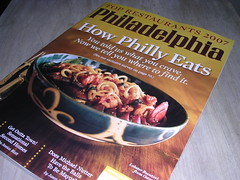
Philadelphia Magazine’s 2007 Restaurant Issue Highlights Philly Food Bloggers

Philadelphia Magazine surveyed Philly restaurant lovers to uncover their eating habits and dining proclivities. Then, in its annual 2007 restaurant issue, it used these statistics to categorize and recommend local eateries based on these diners’ dispositions.

Turns out that 70% of those surveyed get their restaurant recommendations by word-of-mouth. Philadelphia Magazine gets some of its recommendations by “word-of-screen,” so it thought it would direct this 70% toward its favorite Philly food bloggers: Foobooz; Messy and Picky; and, yours truly, PhilaFoodie. eGullet's Pennsylvania bulletin board also gets a shout out for hosting lively restaurant debates.

If it didn’t hit your mailbox yesterday, you should be able to find this issue of Philadelphia Magazine on store shelves today.

And, while we’re at it, an extra special congrats to Foobooz for being named Best Food Blog by Philadelphia Weekly's food critic, Kirsten Henri. (Very well deserved; Foobooz is unsaveably addictive.)

Read More....

December 14, 2006

Craig LaBan Unmasked

To be quite honest, I was surprised to learn that Craig LaBan—the restaurant critic for The Philadelphia Inquirer—would be appearing live and in person Tuesday evening to give a talk at the Penn Bookstore. Anonymity is a restaurant critic’s stock-in-trade. It is what gives him or her the luxury to experience a restaurant the way we do—in its normal state of affairs with all of its little imperfections on display. In LaBan’s case, if the restaurant staff discovered they were serving the only critic in town who has the power to move the market, things could get a bit awkward. LaBan maintains that he does not need anonymity to craft an effective review—after all, he says, they still have to cook the food, and ultimately that’s the focus of the review. Yet, he has gone to great lengths in the past to protect his identity. One of the most famous examples took place when LaBan won the James Beard Foundation award in 2000, food writing’s most prestigious award; he refused to attend the banquet because the industry reps in attendance would see what he looked like. And so the question became: How would LaBan pull off his appearance at the Penn Bookstore? Would he even show at all?

The purpose of this rare public appearance was for LaBan to promote his new book—The Philadelphia Inquirer Restaurant Guide. LaBan’s guide is an essential read not only for those who enjoy exploring the Philadelphia restaurant scene but also for those who appreciate good food writing. As you would expect, the book provides you with all of the utility you want in a restaurant guide, including indices that organize the restaurants by various categories. But LaBan serves up much more. The guide reads like literature. And LaBan is the consummate storyteller, treating you to a level of depth and expertise about the Philadelphia restaurant scene that only he can deliver.

LaBan feeds you detailed, eloquent reviews of his 76 favorite Philadelphia restaurants, all of which have been updated for the new book. LaBan’s prose will vividly transport you to his dinner table, his sensory details so crisp and engaging you’ll be convinced you shared the meal with him. In the margins of each of these 76 reviews, LaBan fleshes out the scene even further by delivering bullet point highlights about the menu, the wine list, the weekend noise level and even parking options, among other things. In addition to his 76 favorites, you’ll also find concise capsule reviews of over 600 more area restaurants.

But, as a guide, what sets this book apart from the others are LaBan’s essays. Peppered throughout the book are nine densely informative and richly entertaining essays about features unique to the Philadelphia restaurant scene, including the BYOB phenomenon, truck fare and (of course) cheesesteaks. Digest these and you’ll feel like you own the city.

Before LaBan emerged and took the podium at the Penn Bookstore, the buzz in the crowd was all about his identity. And when he did finally appear, he fully embraced the moment, donning a wizard’s cape and shielding his face with his signature baguettes. The crowd laughed as he distributed the bread for us to eat (we were missing dinner, after all), and before we knew it, he had opened his spell book and had already begun to mesmerize us with one of his essays. At that point, the buzz about his appearance was forgotten. All we could see was the Yue Kee truck in University City and the “soft half-moons of violet-skinned Asian eggplants” he was describing.

Afterwards, LaBan graciously posed for this picture, which he gave me permission to publish on my blog:

Craig LaBan Unmasked

So, the next time you spy a man in a wizard’s cape across the room from you at your favorite trattoria enjoying a whole, grilled Branzino prepared tableside, please don’t stare or call attention to the man. Just let him eat in peace. After all, it could be Craig LaBan.

Read More....

December 10, 2006

Les Verrières - Clos des Soutyères, Coteaux du Languedoc 2004 (PLCB No. 20202)

Les Verrières - Clos des Soutyères, Coteaux du Languedoc 2004 (PLCB No. 20202)

The Clos des Soutyères from Les Verrières hails from within the Languedoc-Roussillon region of Southern France, a region known for producing wines at the value end of the spectrum. It is a blend of Syrah, Grenache and Carignane (the varietal primarily responsible for this wine’s aggressive tannins and 14% alcohol content). This is a bold red. You’ll taste a quartet of darks—dark cherries, dark plum, dark chocolate and dark coffee. The finish is long; the chocolate seems to hang on forever. But the tannins have even greater stamina, tingling your gums long after the chocolate has disappeared.

In addition to how it tastes, though, there are two other important reasons you should try this wine. First, it’s a rare opportunity to get a highly rated wine at a very reasonable price. Most wine drinkers, including me, spend a lot of time tracking down great values. And there are some gems out there to be found, even if you do have to sift through a lot of ore sometimes to find them. This is one of those gems.

This wine from Les Verrières is not only reasonably priced at $22.99, but it is also highly rated. In August 2006, Wine Spectator rated this wine a 91. To give you some perspective on what a good deal this is, the 2001 Silver Oak, Napa Valley—a highly coveted and insanely popular cult Cab from California—is rated an 89 and the PLCB charges $99.99.

Some people dismiss wine scores for being subjective and as being nothing more than a marketing tool. Back in August, the New York Times took aim at 100-point wine rating systems because of how wine marketers have been exploiting them. For example, marketers will often trumpet a 90 but ignore an 89, implying that the scores reflect an objectivity and a precision that even respected wine critics will readily admit (and most intelligent consumers already know) just isn’t possible. Some wine merchants have even been accused of inventing high scores to push their wines, affecting the credibility of wine scoring in general.

That being said, a score can still be a useful guide if it comes from a reliable source such as Wine Spectator (Robert Parker’s Wine Advocate and Stephen Tanzer from Food and Wine Magazine are also in that category). And at $22.99, this is great opportunity to experience a 91 from Wine Spectator and incorporate that experience into your wine vocabulary.

The second reason you should try this wine is because it comes from a very limited production. The reason this is important, at least for PA wine consumers, is because of what it may represent—progress.

Pennsylvania’s wine distribution system has taken its lumps over the years. It has been called draconian and has often been criticized as being antagonistic to wine consumers in terms of price and selection. PLCB Chairman Jonathan Newman has done a lot over the past few years to change that. You still may not be able to buy wine at your local grocery store or escape the Johnstown Flood Tax, but things have gotten a whole lot better. The PLCB is now leveraging its buying power as the largest wine purchaser in the country to get some great deals, some of which it offers as Chairman’s Selections. The PLCB also is now offering more high-end wines, although its buying power does not always have the same muscle at this end of the spectrum (for example, the PLCB charges $135 for the 2003 Chateau Ducru-Beaucaillou, a widely-available Second Growth Bordeaux, but it lists elsewhere for $125).

But the one area the PLCB does not focus on is offering wine that is produced in small quantities, which are often some of the most sought-after wines in the world. You can’t blame the PLCB for not pursuing small productions; even in states that have privately run wine distribution systems, a wine merchant can have a hard time landing these desirables. Plus, buying small productions doesn’t seem to fit with the PLCB’s buying model. If you’re buying wine for the whole state (even just the specialty stores), it doesn’t make sense to buy wine produced in quantities so small that you couldn’t offer it in all of your stores. In addition, wine makers that have small productions probably aren’t seduced by the PLCB’s buying power. Even if they had enough product for the PLCB, it’s unlikely that they’d be interested in cutting any sort of deal given that small productions are usually in very high demand, especially if their wine is highly rated.

That’s what makes the Clos des Soutyères such an interesting find here in PA. Les Verrières made only 1,000 cases of this wine, which is a very small production. The PLCB not only managed to capture 403 of the 1,000 cases made, but it was able to get them at a discount (it was quoted at $30)—an amazing coup for a wine rated 91 by Wine Spectator. It is possible that the PLCB just got lucky—maybe it inked the deal with Les Verrières prior to August 2006, something Les Verrières may not have been willing to do had the Wine Spectator rating been published sooner. But even if that is true, at a minimum it shows that the PLCB recognizes the value in opening dialogues with small producers and (hopefully) building lasting relationships with them.

It is not often that you’re able to find a highly rated wine produced in small quantities at a great price. So, you should take advantage of this opportunity while you can. The Les Verrières - Clos des Soutyères (PLCB No. 20202) is available at the PLCB’s Premium Collection Stores.

Read More....

December 02, 2006

Guacamole or Guaca-faux-le?

According to an article in Thursday’s LA Times, a California woman filed a class action lawsuit against Kraft for misrepresentation because its guacamole dip didn’t have enough avocado in it.

Now, just hold on a minute. I know what you’re thinking—another frivolous lawsuit, right? Wrong. You should be ashamed of yourself. Read the LA Times article. Believe me, you don’t file a lawsuit like this unless you have an FDA rule tucked under your belt telling you exactly how much avocado should be in guacamole.

“[T]he Food and Drug Administration has no legal standard mandating how much avocado should be in guacamole.”
OK, so there’s no FDA rule. No worries. That doesn’t mean the package isn’t misleading. Certainly, for someone to actually file a lawsuit against Kraft for misrepresentation, the label must not list how much avocado is in the dip.

“If consumers read the fine print, they would discover that Kraft Dips Guacamole contains less than 2% avocado … All of the ingredients are listed on the label for consumers to reference.”
Alright, alright. So the package tells you exactly how much avocado is in the dip. But that doesn’t mean she hasn’t been injured. You can’t sue somebody unless you’ve been injured. And I’ll bet you dollars-to-donuts that she suffered some grave and serious injury—one that will tug at the jury’s heartstrings, one that we can all relate to.

“Brenda Lifsey, the plaintiff, said she made a three-layer dip with Kraft guacamole last year only to discover that it contained almost none of the ingredient she most expected: avocado. ‘It just didn't taste avocadoey,’ said Lifsey….”
OK, so…no injury either. Hmm. Well, look, don’t judge this woman too harshly. I mean, it’s not like she’s one of those people who has made a career out of suing large corporations.

“Lifsey has been a plaintiff in other lawsuits against large corporations. A few years ago, she joined a lawsuit against Sears, claiming that the retailer misrepresented that its Craftsman tools were U.S. made. That case is still in the courts. She also was part of a suit filed last year against vehicle reporting service Carfax Inc., alleging that it did not have access to police accident reports in California and other states even though it advertised that it could provide vehicle history records. Carfax denied the claims.”
Oh well, Brenda. I tried.

Read More....

November 20, 2006

The Oceanaire Seafood Room

The Oceanaire Seafood Room

The Oceanaire Seafood Room is a rapidly growing, high-end seafood chain that just docked in the Washington Square section of Philadelphia. Oceanaire is a unique dining experience, a tribute to a bygone era. The atmosphere is that of a tasteful 1930s supper club aboard a luxury ocean liner—complete with grand Art Deco curves, cherry wood accents, comfy red leather booths, and big band music drifting through the air.

Oceanaire's Art Deco

The service, too, is nothing short of first class. Even if you’re not a judge, or a doctor being wooed by a pharmaceutical rep, the staff at Oceanaire will make you feel just as important.

Oceanaire's Dining Room

But as impressive as the décor and service are, they merely act as a backdrop to showcase the two concepts for which Oceanaire is notoriously famous. First, Oceanaire boasts that its fish is “Ultra-Fresh”—what you’re eating today was likely swimming in the ocean yesterday afternoon. The menu changes daily depending on market availability. Executive Chef Anthony Bonett is in his element; he spearheaded the late Opus 251’s market fresh approach.

Oysters

Given the obsessively high rotation of its inventory, you would be remiss if you didn’t experience Oceanaire’s raw oyster bar, which offers a bevy of bivalves from both coasts. We tried the Effingham, Kumamoto and Netart Bay ($2.10 per oyster). The Effingham were briny and a little sweet, the Kumamoto were rich and buttery, and the Netart Bay were also briny and mild.

Jumbo Lump Crab Cake

Another must-have is the Jumbo Lump Crab Cake ($13.50 as an appetizer, around $26 as an entrée). Each hulking crab cake is pure jumbo lump crab meat. There must be some small amount of filling holding it all together, but it’s virtually impossible to detect. The crab cakes are broiled and come with Oceanaire’s signature Mustard Mayonnaise, which adds an addictively rich, zesty kick.

Striped Sea Bass

Oceanaire’s menu is vast, yet navigable. There are two ways to have the daily catches prepared: (1) simply grilled or broiled; or (2) as one of the chef’s daily specialties. My wife chose the Striped Sea Bass simply broiled ($25.95). From the first bite to the last, the uncomplicated preparation of this dish was a constant reminder of how fresh the fish really was.

While the Ultra-Fresh experience may be a lure for many fish lovers, others may see it as an anchor. Oceanaire’s fish dishes, even its specialties, are prepared in a way that highlights—or, at a minimum, does not overshadow or compete with—the freshness of fish. However, fish lovers looking for more celestial or sublime compositions may not always be wowed by this approach.

Black Cod with Orange Ginger Sauce

The Black Cod special, for example, was prepared with a light, delicate orange ginger sauce ($28.95). On another occasion I had the Mahi Mahi special, which was rubbed with Cajun spices and accompanied by a dollop of blue cheese ($23.95). The specialties were tasty and merit repeating. However, it would be interesting to see what the kitchen could do if it sailed into deeper waters.

Mahi Mahi with Cajun Seasonings and Blue Cheese

The second concept Oceanaire is famous for is that everything comes in only one size—titanic. The entrées are essentially double portions. The sides, which come a la carte, are so large that each one easily could feed a table of four. However, some of the sides (such as the roasted potatoes) are a little too simply prepared and could benefit from some creative chefing.

Oceanaire's Bar

Oceanaire’s bigger-is-better mentality also carries through to the bar, making it a pearl for those hunting for an economical cocktail hour. A glass of 2005 Mark West Pinot Noir at Oceanaire will set you back $12 (only slightly more than other restaurants); however, you’re getting a generous double pour. Similarly, a Chopin martini costs $12.95, but it’s basically a double. It’s also worth noting that Oceanaire’s long, sleek metal bar and its neighboring curved wooden bar are perfect places for those who occasionally dine alone.

Wine Glass on Steel

Oceanaire is among a small, elite group of Philadelphia restaurants that have earned Wine Spectator’s Award of Excellence—which means it has a well-chosen selection of at least 100 wines by quality producers and a thematic match to the menu in both price and style. Oceanaire has dozens of wines by the glass and even more by the bottle. There’s even a small selection of half bottles. Oceanaire also has a separate Captain’s List of wines, which has an impressive selection of hard-to-find bottles that hover in the triple digits.

Oceanaire’s Ultra-Fresh selections and gargantuan portions make it a Disneyland for fish lovers. One bite and you could be hooked.

The Oceanaire Seafood Room
700 Walnut Street
(215) 625-8862

Read More....

November 17, 2006

The 2006 Beaujolais Nouveau Has Arrived

2006 Beaujolais Nouveau
Every year on the third Thursday of November the new vintage of Beaujolais Nouveau is released to the public. This year that day was yesterday—November 16, 2006.

In France, the timing of Beaujolais Nouveau’s release is governed by law (it cannot be served before 12:01 a.m. on that special Thursday), and its release is celebrated with a certain degree of gimmicky fanfare. The U.S. also celebrates its release, albeit to a lesser degree, due to an international marketing campaign largely credited to Georges Duboeuf, Beaujolais Nouveau’s largest producer.

Beaujolais Nouveau is made from the Gamay grape, which is harvested, fermented, and bottled all in about six weeks. The result is a light, fresh, fruity red. Because this young wine is also relatively acidic and lacks the tannins and oakiness characteristic of many red wines, it is often touted as a safe way to introduce reds to those who prefer white wine. For that same reason, though, some wine purists harbor contempt for Beaujolais Nouveau, calling it Kool-Aid and dismissing the faux holiday that spawns from the Duboeufian marketing blitz.

Nevertheless, Beaujolais Nouveau is an inexpensive wine that remains popular, making its way to many Thanksgiving tables every year. It is best served chilled to about 55 degrees. This wine has a short shelf life and, traditionally, it is not consumed after January 1. Although it likely will have a bit of life left in it after the first of the year, by late spring it’s usually too far gone to be enjoyable.

This year, the PLCB is offering the same two brands of Beaujolais Nouveau it offered last year: the Georges Duboeuf Beaujolais Nouveau and the Leonard de Saint-Aubin Beaujolais-Villages Nouveau. Here’s how they rate:

Georges Duboeuf Beaujolais Nouveau 2006 (PLCB No. 5877, $11.99). The color is a deep red. The nose and palate show strawberries, raspberries and cherries. This Beaujolais Nouveau is much heartier than I expected and has a respectable balance between the fruitiness and the acidity. The finish is remarkably smooth.

Leonard de Saint-Aubin Beaujolais-Villages Nouveau 2006 (PLCB No. 8998, $11.99). Beaujolais-Villages is a separate appellation unto itself. It is known for producing a Nouveau that is firmer and more robust than your standard Nouveau. The Beaujolais-Villages Nouveau typically lasts a little longer, too. Last year, the Saint-Aubin was my favorite of the two because it had a bright, explosive cherry flavor and a charming bite. This year’s Saint-Aubin, though, is less impressive. Compared to the Duboeuf, the color is lighter and the palate is thinner, grittier and more tart. Cherry remains the principal flavor, but it’s not as explosive as it was last year. More importantly, unlike last year the fruitiness of this year's vintage is somewhat masked by its forward acidity.

That being said, I still lean toward the Saint-Aubin. The Duboeuf is probably more approachable due, in part, to its balance and smooth finish. But the Saint-Aubin’s rough edges have a certain appeal.

Read More....

November 15, 2006

The Debut of Fork You!

The blog is less than a day old and has only one post under its belt. But it may already be the best food blog on the Internets.

Two icons of the Philly blogosphere, Marisa (Apartment 2024) and Scott (Blankbaby), have teamed up to create Fork You!—Philly's first food vlog (that's right, folks; the "v" is for video). Fork You! is all about "Food with Philadelphia charm." Their first video podcast teaches you how to make sushi. Marisa walks you though the entire process, from selecting fish at Reading Terminal Market to the proper way to roll it all up. In addition to his production skills, Scott provides witty commentary along the way and even tries his hand at building a roll. These two are a natural team. The second episode has already been shot.

Fork You! is must-eat TV. Tune in and see for yourself.

Read More....

November 14, 2006

Blinq Dishes on Philly's Food Blogs

Like most people, Daniel Rubin spends his work day in front of a computer scouring the Internets for interesting blogs. However, unlike most people, he actually gets paid to do it—by the Philadelphia Inquirer. He presents his daily findings, along with a healthy dose of spirited wit and wisdom, at Blinq.

Today, in a post called Food for Thought, Daniel explores the growing niche of Philadelphia food blogs. The field was barren a little over a year ago, he notes. Now, there are more opinionated foodies blogging about Philly restaurants than you can shake a Whiz wit at. Daniel has corralled 8 blogs (including yours truly, a site he kindly says is "something to bank on") and 6 service sites for your perusal. Each one serves up Philly’s vibrant restaurant scene in its own unique way; the perspectives they bring to the table are as diverse and dynamic as the Philly restaurant scene itself.

An abbreviated version of Daniel's article also appears here in the Magazine section of the Nov. 15, 2006 Philadelphia Inquirer.

Thanks to Daniel for highlighting this little corner of the Philly blogosphere. I’ve added the new faces he discovered to the bulging PhilaFoodie Resources section on the right.

So, what are you waiting for? Dig in.

Read More....

November 10, 2006

Winner of the October/November 2006 Palate Ballot

Well, folks, much like the mid-term elections, “[i]t was a thumping” here at the Palate Ballot.

The American people have voted and their message is clear. The winner is Bar Ferdinand. Here’s the break down:

1. Bistro 7: 5 votes.
2. Pif: 5 votes.
3. Bar Ferdinand: 29 votes.
4. N. 3rd: 0 votes.

Had the Secretary of Defense resigned sooner, N. 3rd may have had a chance. I guess that was one of those unknown unknowns. Then again, you go with the Palate Ballot you have, not the Palate Ballot you don’t have.

Thanks to everyone who voted, especially those who left colorful comments. The Palate Ballot will return soon. Until then, keep an eye out for my upcoming review of Bar Ferdinand.

Photo Credit: REUTERS/Larry Downing

Read More....

November 05, 2006

Castellani Toscana Biagio 2001

Castellani Toscana Biagio 2001

On the nose: Not a powerful nose. Bright red cherries and oak.

On the palate: This Tuscan red is a blend of Sangiovese (85%) and Cabernet Sauvignon (15%). Tart cherry flavors carry the palate. Not overly complex, but some detectable tobacco and chocolate on the finish with a hint of vanilla from the oak. True-to-form for Sangiovese, it has a crisp acidity and soft tannins. A solid performer to be enjoyed now.

On the wallet: The Castellani Toscana Biagio 2001 (PLCB No. 005976) is a comfortable $12.99. It is available at the regular and premium PLCB stores.

On the table: Sangiovese is tailor-made for food. The higher acidity in this wine makes it a perfect match for tomato sauce-based dishes and full-flavored pastas.

N.B.: Keep an eye out for the Castellani Toscana Biagio 2003; Wine Spectator calls it a Best Buy and rates it an 88.

Read More....

November 03, 2006

Gophila.com’s Interactive BYOB Restaurant Map

If you love Philly’s BYOBs, you’ll love this.

The folks at the Philly Tourism Office put together this really cool interactive BYOB restaurant map. Not only does it identify the locations of about 130 BYOB restaurants in the area, it also identifies all of the nearby PLCB stores. You can sort by neighborhood or cuisine. Click on any of the restaurant or PLCB locations and you’ll see a bubble that lists an address, a phone number and a web site (if any). And with the restaurants, you’ll also get a short description. Soon they’ll be adding “send to cell phone” and “get directions” features.

Check it out: http://www.gophila.com/byobmap

Read More....